
A Case Study
The Root River State Trail
The Root River State Trail is one of those places that now feels inevitable — scenic, busy, beloved, and central to the identity of southeast Minnesota. But its success was not inevitable at all.
According to the history, the trail was authorized by the Minnesota Legislature in 1971, with the state later purchasing 49 miles of abandoned rail bed in 1981. Development began in 1985, the core trail opened in 1988, and the route was later extended from Rushford to Houston in 1998. The larger system now includes the Root River and Harmony-Preston segments, together forming roughly 60 miles of paved multi-use trail in the Driftless region.
That tidy history can make the project sound straightforward. It wasn’t.
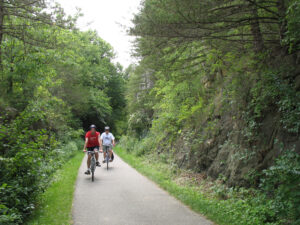 Charles Ruen, a farmer near Lanesboro, offers a useful perspective on what trail opposition can look like in rural communities.
A Rails-to-Trails Conservancy report recounts that Ruen was initially against the Root River trail when it was first proposed on an out-of-service Milwaukee Road corridor running through farm country. His concern was practical: he did not want people biking and walking “through the middle of his fields,” and he doubted the trail would get enough use to justify the disruption. The report quotes him saying, “Originally I was opposed… Trails were quite new. I didn’t think it was going to be used enough.” It also says he helped organize a group of farmers to try to purchase the right-of-way to stop the rail-trail project.
That viewpoint makes sense in context. Trails were still a relatively new concept in many rural areas. Landowners faced uncertainty about privacy, trespassing, safety, and how trail users might affect farm operations. The promised benefits were speculative at the time, while the perceived risks felt immediate and personal.
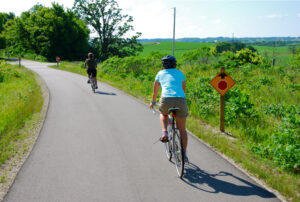 What makes Ruen’s story compelling is not just that he opposed the trail — it’s that he later revised his view after seeing the results.
The same Rails-to-Trails Conservancy account says the trail became “wildly popular,” and Ruen adapted in a characteristically practical way: he converted an old farmhouse on the trail into a bed-and-breakfast and operated it for more than 15 years. The report quotes his later assessment of the Root River State Trail: “It’s been good—I’ll have to say that. It’s brought a lot of benefit to this part of southeastern Minnesota. It far exceeded what I thought would happen.”
Today, the Root River State Trail is widely seen as a signature outdoor asset for the region, but Charles Ruen’s story reminds us that successful trail projects often begin with conflict and skepticism, not consensus. The trail’s eventual popularity — and the way local businesses and communities benefited — helped answer opponents’ concerns over time.
By Kstoerz – Photography., CC BY-SA 3.0, Link
Source: Rails to Trails Conservancy
 English
  Español de México
  Français
  Italiano
  Deutsch