
Know Your Ride. Know the Law.
A community safety guide to e-bikes, e-motos, scooters and electric mobility devices
Used properly, e-bikes are a genuine public health win, giving older adults and people with limited mobility an affordable way to stay active, independent, and engaged in their community, without the risks that come with high-powered e-motos.
That being said electric bikes are everywhere, but not everything sold as an “e-bike” actually is one. This page breaks down what Maryland law actually says, so you can ride safely, buy smart, and stay legal.
The Problem: Not All “E-Bikes” Are E-Bikes
Many buyers reasonably assume that anything marketed as an “e-bike” is a low-speed, kid-friendly bicycle. It’s not always true. High-powered electric motorcycles and mopeds, often called “e-motos”, are increasingly sold and marketed as e-bikes, both online and in stores, often without clear warning that they’re legally motor vehicles.
That confusion has real consequences: for parents buying a device for their child, for riders who don’t realize they need a license, and for the broader safety of everyone sharing the trails and the road.
No matter the type of device, its critical that riders wear a helmet at all times! Need a helmet? Email heather@talbotthrive.org to get one for free!
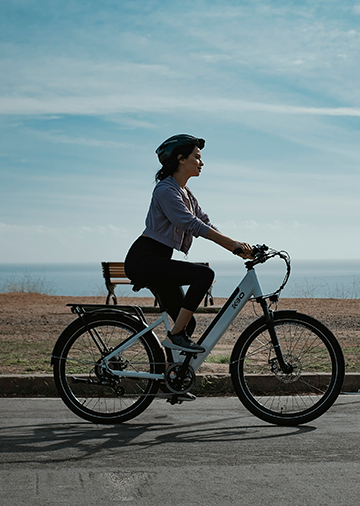
E-Bike or E-Moto? Here’s the Difference
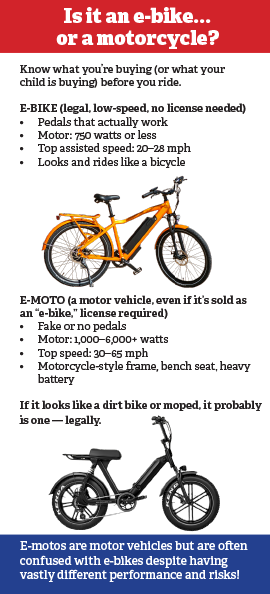
E-Bike (legal, low-speed, no license needed)
- Pedals that actually work
- Motor: 750 watts or less
- Top assisted speed: 20–28 mph (Class I, II and II)
- Looks and rides like a bicycle
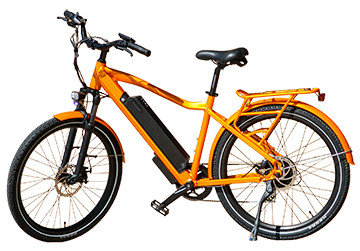
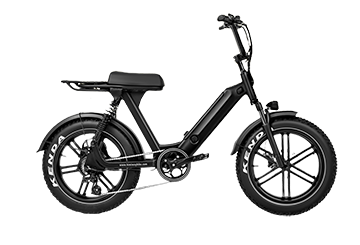
E-Moto (a motor vehicle — even when it’s sold as an “e-bike”)
- Fake or no pedals
- Motor: 1,000–6,000+ watts
- Top speed: 30–65 mph
- Motorcycle-style frame, bench seat, heavy battery
Why This Matters
Crashes involving e-bikes and e-motos have been rising across the region and the country, as these devices have grown rapidly in popularity among riders of all ages. High speeds, heavy vehicle weight, and inconsistent helmet use all raise the risk and severity of crashes — and many riders and parents don’t realize how different an e-bike and an e-moto really are until something goes wrong.
What Maryland Law Actually Says
Maryland defines a legal electric bicycle (Md. Transportation Code §11-117.1) as a bicycle with:
- Working pedals
- A motor of 750 watts or less
- Class 1 & 2: motor assist stops at 20 mph
- Class 3: motor assist stops at 28 mph
Class 1–2 e-bikes can be ridden like a regular bicycle — no license, registration, or insurance required. Class 3 riders must be 16 or older.
All riders under 16 must wear a helmet.
If a device exceeds 750 watts or 28 mph, Maryland treats it as a moped or motor scooter — a motor vehicle, not a bicycle. That means:
- Title and registration required with the MVA
- Insurance required
- A driver’s license or moped permit required (must be 16+)
- A DOT-approved motorcycle helmet and eye protection required
- Riding one unregistered or unlicensed can mean citations, fines, and points against a driving record
(Md. Transportation Code §§11-134.1, 11-134.5, 16-104.2)
E‑Bike Maintenance Tips
Regular maintenance helps ensure your e‑bike stays safe and performs well. Perform an ABC Check Before Every Ride
A – Air: Make sure your tires are properly inflated.
B – Brakes: Confirm the brakes engage correctly and stop the bike effectively.
C – Chain / Components: Check that the chain, gears, and controls are functioning properly
Battery Safety
A few simple habits keep your battery running safely and lasting longer:
- Use the right charger: only use the manufacturer-approved charger and unplug once fully charged
- Store in a cool, dry place: extreme temperatures degrade battery life and can create safety risks
- Watch for warning signs: swelling, unusual heat, strange smells, or sudden range loss mean it’s time for service
- Avoid full discharges: topping off after rides extends battery lifespan
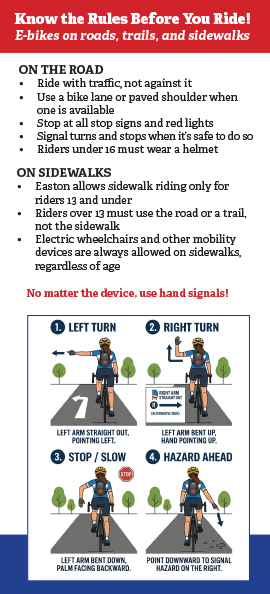
Riding Safely: Roads, Trails, and Sidewalks
On the road:
- Ride with traffic, not against it
- Use a bike lane or paved shoulder when available
- Stop at all stop signs and red lights
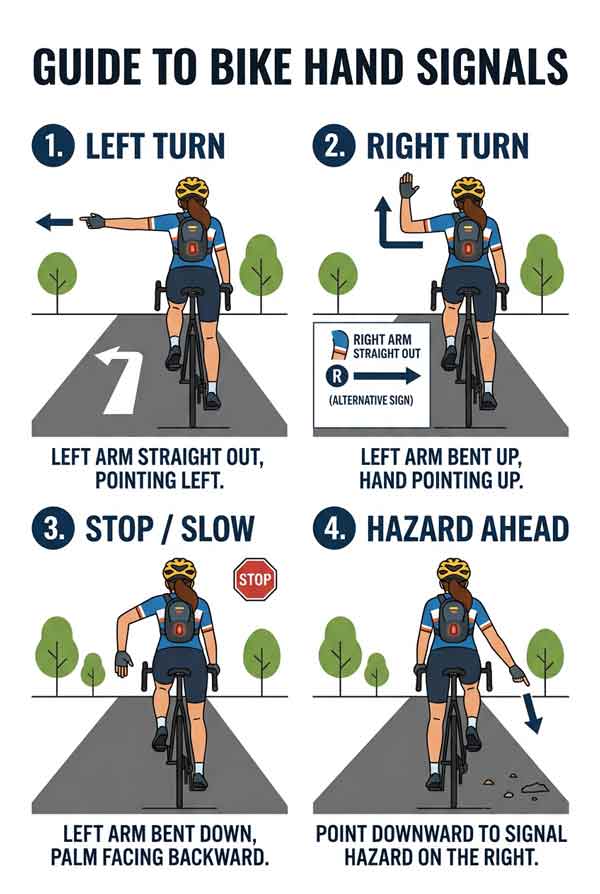
- Signal turns and stops when it’s safe to do so
- Riders under 16 must wear a helmet
On sidewalks:
- In Easton, sidewalk riding is allowed only for riders 13 and under
- Riders over 13 must use the road or a trail
- Electric wheelchairs and other mobility devices are always allowed, regardless of age
On trails — share the space:
- Slow down around walkers, runners, and other riders
- Announce yourself before passing (“on your left” works)
- Stay to the right; pass on the left
- Yield to pedestrians and slower trail users
- Keep a safe, controlled speed
(Md. Transportation Code §§21-1205.1, 21-1205.2, 21-1207.1; Easton Town Code Ch. 5)
Get the Rack Cards
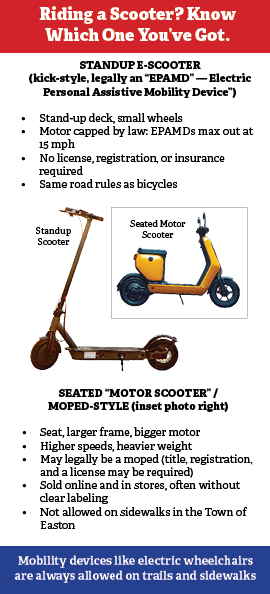
Printed reference cards covering e-bikes vs. e-motos, e-scooters, and trail/road rules are available at locations throughout Talbot County, including local bike shops, libraries, schools, and town offices. Download PDF versions below or email us to get the printed versions for your location.
 Français
  English
  Español de México
  Italiano
  Deutsch