
The way we plan highway projects overlooks health. We can fix it.
By Megan Weil Latshaw
December 12, 2025 7:24 pm.
Transit planning focuses too much on moving more cars on more roads, but there are hidden costs, writes Megan Weil Latshaw, who says a broad-based approach to planning can help everyone.
They affect how we plan our day, what time we leave our homes, what time we’ll be back and how much time we have for other things. What we often overlook is how transportation infrastructure, and the way our communities are designed, impacts our health (both physical and mental).
Although many Marylanders rely on our highway system to get around, the way we traditionally plan highway projects comes with many externalities – indirect costs not accounted for when budgeting the project – such as more pollution, increased vehicle crashes and lack of affordable mobility choices.
Vehicles are a major contributor to ozone pollution and the largest source of carbon emissions, which in turn fuels climate change. Additionally, dust from brake pads and tires releases particulate matter pollution (including soot). Air pollution triggers asthma symptoms, diminishes lung function, triggers heart attacks, causes adverse birth outcomes and increases the risk of cancer as well as premature death.
I’ve seen firsthand how this impacts urban communities like Baltimore City, where my daughter grew up and had to frequently carry an inhaler with her. In several places I’ve lived and worked in the city, it was common to see a layer of black dust on furniture due to particles in the air.
Visits to emergency departments for asthma are much higher in locations that are in violation of federal air quality standards for ozone, including Baltimore City and Baltimore County.
Additionally these emergency department visits for asthma are much more frequent — nearly five times higher — among Black children aged 2-17 years compared to white children. When we build projects intended to increase driving, we often fail to account for the costs of dealing with these health impacts, especially for communities located near highways.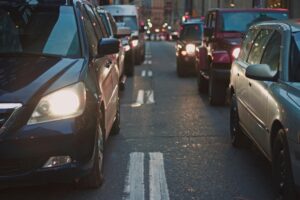
Not only does how we design highway projects impact our health, it also impacts our safety.
Last year there were 571 people, including 159 pedestrians or cyclists, who were tragically killed in a car crash in Maryland.
Encouraging more driving and car-dependent infrastructure increases the risk of such crashes. When a four-lane highway becomes a six-lane highway, a pedestrian has to cross a wider distance with more cars, more noise and more car exhaust.
Luckily, policies like the Transportation and Climate Alignment Act (TCA) that will be introduced again next year by Del. Mark Edelson (D-Baltimore City) and Sen. Shelly Hettleman (D-Baltimore County) can help combat these issues. The Transportation and Climate Alignment would require that Maryland mitigate the harmful pollution from new highway expansion projects by investing in transit, pedestrian and cycling infrastructure as part of the project itself, or prioritize these investments in the area where the project is located.
Spending time in Bruges, Belgium, I recently got to see firsthand what a car-free downtown looks like – vibrant with people walking and biking everywhere. My daughter and I took a city shuttle, a train, the subway, bikes and a bus, only opting for cars (which were electric) twice.
If we focus on helping people get to destinations safely and conveniently rather than cars moving as quickly as possible, then we can start to solve the real problem – whether that is a jobs-to-housing imbalance or lack of amenities (grocery stores, parks, health care, etc.) near where people live.
All communities benefit from infrastructure that helps people walk, bike or take transit. Each Maryland county (including Baltimore City) annually sends a “priority letter” of key projects to fund. Nearly every county has been requesting transit, bike or pedestrian options – whether that is a Southern Maryland Rapid Transit project in Charles County or the implementation of a first fixed-route transit service in Garrett County.
These investments boost our physical and mental health, making it easier to get physical activity and improving access to nature and social activities. They are also good for our pocketbooks given that gas prices and car maintenance cost people thousands of dollars each year. In fact, transportation is the second-largest household cost after the cost of housing in Maryland.
We can plan better and healthier by building infrastructure and policies. Legislation like the Transportation and Climate Alignment Act help steer us in the right direction.

Megan Weil Latshaw, PhD, MHS
Megan Weil Latshaw, PhD, MHS, serves as director of the master’s degree programs in the Department of Environmental Health & Engineering at Johns Hopkins University and as co-director for the Education Program of the Institute for Planetary Health. She teaches at the undergraduate and graduate levels. Opinions expressed are her own and do not represent the university.
© Maryland Matters, 2025
v1.98.3
Maryland Matters is a trusted nonprofit and nonpartisan news site. We are not the arm of a profit-seeking corporation. Nor do we have a paywall — we want to keep our work open to as many people as possible. So we rely on the generosity of individuals and foundations to fund our work.
Maryland Matters is part of States Newsroom, the nation’s largest state-focused nonprofit news organization.
 Español de México
  English
  Français
  Italiano
  Deutsch